Saints of the World: Why Orthodox Christians Venerate Icons

The Faith and the Icon
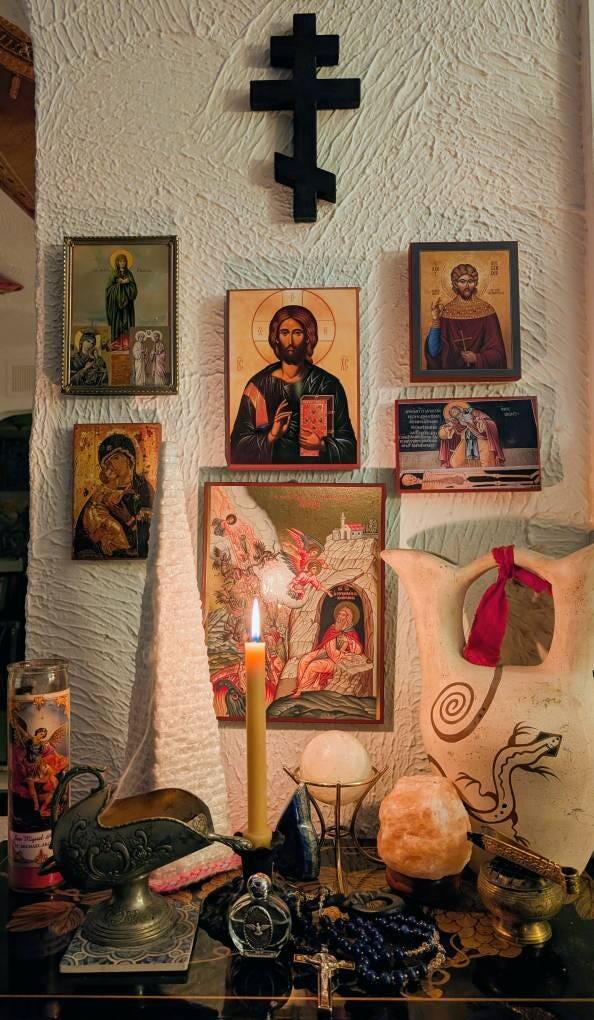
In almost every Orthodox home, icons of Christ, the Theotokos and the saints look out from the wall, a small lamp burning before them. Here is why Orthodox Christians venerate icons of the saints, and why that honour is never worship.
In short Because God became man in Christ, He can be painted, and so can the saints who shine with His grace. We honour the icons; worship belongs to God alone.
At a glance
- What icons are
- Images of Christ, the Theotokos, the angels and the saints, made for prayer
- Their basis
- The Incarnation: in Christ the invisible God became visible
- Honour, not worship
- Icons receive veneration (proskynesis); worship (latreia) is for God alone
- The council
- Seventh Ecumenical Council, Nicaea, 787
- Restored
- 11 March 843, under Empress Theodora and Patriarch Methodios
- The feast
- Sunday of Orthodoxy, first Sunday of Great Lent; next on 21 March 2027
- Their defender
- St John of Damascus, remembered on 4 December
Why do Orthodox Christians venerate icons of the saints?
Many admire icons as art, and they are. But for an Orthodox Christian an icon is first a confession of faith: God truly became man.
No one could paint the invisible God. Yet in Christ He took a human face that could be seen and touched, and so, wrote St John of Damascus, He may be painted.
The saints show the other side of the mystery. “The Son of God became man, that we might become god,” wrote St Athanasius: by grace, not by nature. This is theosis, and a saint’s icon shows a human face filled with that grace.
Icons are theology in line and colour, a mirror of the living Church. St John put it plainly: what a book is to those who can read, an image is to those who cannot.
Veneration, not worship: what did the Seventh Ecumenical Council teach?
In the 8th century, emperors in Constantinople moved against the holy icons, and many were destroyed. In 787 the bishops met at Nicaea for the Seventh Ecumenical Council.
The Council drew a clear line. Icons of Christ, the Theotokos, the angels and the saints receive honour: a bow, a kiss, incense and light. This is proskynesis, honourable veneration. Worship in the full sense, latreia, belongs to God alone.
So we speak of venerating icons, never of worshipping them. The Council’s key sentence is St Basil the Great’s: the honour given to the image passes to its prototype, the person it shows.
St John of Damascus, defender of the holy icons
St John was born in Damascus in the late 7th century, to a Christian family serving at the caliph’s court, and became a monk at the Lavra of St Sabbas near Jerusalem.
When Emperor Leo III moved against the icons in the 720s, John answered, from beyond the emperor’s reach, with three treatises in their defence. His argument was the Incarnation: matter that God has made His own is not to be despised.
He kept latreia for God alone, repeated St Basil’s words about the prototype, and in 787 the Council confirmed his teaching.
“I do not bow before matter; I bow before the God of matter, who for my sake became matter.”
How do you read the icon of St John of Damascus?
Here is St John in an icon from our Exclusive Collection.

- Ο ΑΓΙΟΣ ΙΩΑΝΝΗΣ Ο ΔΑΜΑΣΚΗΝΟΣ “Saint John the Damascene”, written in red on either side of his head.
- The halo A red circle on the gold: the light of God’s grace in a holy life.
- The head-cloth A striped cloth wound round his head; a long grey beard frames a calm face.
- The scroll Held in both hands: the writings he gave the Church in defence of the icons.
- Green and brown A dark green mantle over a brown robe: the plain dress of a monk.
- The gold The gold background shows that what we see belongs to heaven.
What is the Sunday of Orthodoxy?
The struggle over the icons lasted more than a century. It ended on 11 March 843, the first Sunday of Lent, when Empress Theodora, ruling for her young son Michael III, and Patriarch Methodios restored the holy icons.
Ever since, the first Sunday of Great Lent has been the Sunday of Orthodoxy. After the services the faithful carry icons in procession around the church, and the Synodikon, a solemn proclamation of the faith, is read.
Add the Sunday of Orthodoxy to your calendar
The date moves with Pascha each year; in 2027 it falls on 21 March.
The holy icons: a short timeline
- 4th century St Basil writes that honour to the image passes to the prototype.
- 726 Emperor Leo III moves against the holy icons.
- 754 An iconoclast council at Hieria condemns the icons.
- 787 The Seventh Ecumenical Council at Nicaea restores their veneration.
- 843 Icons restored for good; the first Sunday of Orthodoxy.
Why keep icons at home?
The Council itself spoke of icons “in houses and by the wayside”, and most Orthodox homes have an icon corner.
We give icons to those we love and keep them close. We take them with us abroad, even into exile. We make vows before them, and we turn to the saints when there is nowhere else to turn, because we believe they are with us. See our guide to crafting a prayer corner.
Wonderworking icons: whose grace is it?
Some icons are called wonderworking, because the faithful have received healing or help before them. Yet the power is not in the wood or the paint. The grace is God’s.
God works through His saints and through holy things, as with the shadow of St Peter and the cloths of St Paul (Acts 5:15; 19:11–12). An icon is no talisman: miracles come by God’s grace and the faith of the one who prays.
Icons as gifts, and saints of the world
At a baptism, the godparent often gives the child an icon of the saint whose name the child receives.
On a name day, the feast of the saint whose name we bear, an icon of that saint is a natural gift: a Helen or a Constantine celebrates on 21 May, with Saints Constantine and Helen.
And the saints belong to the whole world. St Brendan sailed from Ireland, St Herman and St Innocent brought the Gospel to Alaska, St Nicholas to Japan. Each prays for people far beyond his own land.

The apolytikion of the Sunday of Orthodoxy
We venerate your most pure icon, O Good One,
asking forgiveness of our offences, Christ our God.
For of your own will you were pleased
to ascend the Cross in the flesh,
to deliver those you had fashioned
from the bondage of the enemy.
So with thanksgiving we cry to you:
You have filled all things with joy, our Saviour,
by coming to save the world.
First Sunday of Great Lent
Tip: print this page and the hymn card prints on its own, clean and simple.
Read the hymn in Greek
Τὴν ἄχραντον Εἰκόνα σου προσκυνοῦμεν ἀγαθέ,
αἰτούμενοι συγχώρησιν τῶν πταισμάτων ἡμῶν, Χριστὲ ὁ Θεός·
βουλήσει γὰρ ηὐδόκησας σαρκί, ἀνελθεῖν ἐν τῷ Σταυρῷ,
ἵνα ῥύσῃ οὓς ἔπλασας, ἐκ τῆς δουλείας τοῦ ἐχθροῦ·
ὅθεν εὐχαρίστως βοῶμέν σοι·
Χαρᾶς ἐπλήρωσας τὰ πάντα ὁ Σωτὴρ ἡμῶν,
παραγενόμενος εἰς τὸ σῶσαι τὸν κόσμον.
Questions people ask
Do Orthodox Christians worship icons?
No. The Seventh Ecumenical Council (787) taught that icons receive honour and veneration, while worship belongs to God alone. The honour shown to an icon passes to the person it depicts: to Christ, the Theotokos or the saint.
What does the halo mean in an icon?
The halo shows the light of God’s grace shining in a holy person. In icons of Christ it holds a cross and the Greek letters Ο ΩΝ, “He who is”, the divine name revealed to Moses (Exodus 3:14).
Where should I put an icon at home?
Traditionally on an east-facing wall or in a quiet corner, at eye level, with icons of Christ, the Theotokos and your patron saints, and a lamp or candle. Choose a place where the family can stand and pray together.
What is a wonderworking icon?
An icon before which the faithful have received healing or help, often over many generations. Orthodox Christians believe the miracle is God’s work, through the prayers of the saint and the faith of those who pray, not a power in the wood.
Is an icon a good gift for a baptism or a name day?
Yes. An icon of the patron saint is a traditional baptism gift, often from the godparent, and a natural gift on a name day, the feast of the saint whose name a person bears.
The saints look at us from the walls of our homes, steady and calm, and we know our prayer is heard. Light the lamp before your icons tonight.
Saints of the Greeks… Saints of the World.