St. Xenophontos Monastery and the Wonderworking Hodegetria

Holy Places of Orthodoxy · Mount Athos · No. 4
On the west coast of the Holy Mountain, St. Xenophontos Monastery stands beside the sea under the protection of St George, its patron for a thousand years. It also keeps a wonderworking icon of the Panagia Hodegetria, “She who shows the Way”, which tradition says chose this house in 1730.
In short Founded by St Xenophon in the late 10th century, St. Xenophontos keeps the feast of St George on 23 April and honours the Hodegetria every October. Here are its story, its icon and how to visit with reverence.
At a glance
- Location
- West coast of Athos, between Docheiariou and St. Panteleimon (Ιερά Μονή Ξενοφώντος)
- Founded
- Late 10th century by St Xenophon, whose name it bears
- Dedication
- St George the Trophy-bearer, honoured on 23 April
- Wonderworking icons
- The Panagia Hodegetria (here since 1730, by tradition) and an icon of St George
- Rank
- Sixteenth of the twenty ruling monasteries; a Greek, cenobitic brotherhood
- Jurisdiction
- Self-governed Mount Athos, under the spiritual jurisdiction of the Ecumenical Patriarchate
- Treasures
- 11th-century mosaic icons of St George and St Demetrios; Athos UNESCO-listed (1988)
Where is St. Xenophontos Monastery, and how did it begin?
St. Xenophontos sits right at the water’s edge on the west coast of Athos, the easternmost “finger” of Chalkidiki. Docheiariou is its neighbour to the north, the monastery of St. Panteleimon to the south, and the port of Dafni lies a little further down the coast.
Its founder, St Xenophon, was a monk of the late 10th century, and the house has carried his name ever since. From the beginning it was dedicated to St George.
Two churches of St George
St. Xenophontos has two katholika, or main churches, and both are dedicated to St George. The old katholikon, small and low near the entrance, goes back to around the year 1000. In 1544 a painter named Antonios, of the Cretan school, covered its walls with frescoes.
Among the monastery’s treasures are two mosaic icons of St George and St Demetrios from the 11th century, the two soldier-saints so loved in Thessaloniki.

In 1817 the monks began a much larger church in the northern part of the courtyard. Finished in the 1830s, the new katholikon is counted the largest on the Holy Mountain.
“I am the way, the truth, and the life. No one comes to the Father except through Me.”
The brotherhood today
St. Xenophontos is a cenobitic monastery: the monks share everything, pray together and eat together in the refectory. Archimandrite Alexios has led the brotherhood since 1976, and in 2026 he completed fifty years as abbot.
Like the rest of Athos, the monastery keeps Byzantine time, in which the day begins at sunset. Between the services, some of its monks paint icons in the monastery’s own iconography workshop.
The Panagia Hodegetria that came from Vatopedi
For many years the icon stood on a pillar in the katholikon of Vatopedi, on the north-east coast of Athos. In 1730, tradition says, it vanished from the locked church and was found at St. Xenophontos, about three hours’ walk away.
The Vatopedi fathers thought it stolen, carried it home and sealed the church. Yet the icon left again, with doors and seals unbroken, and was found in the same place at St. Xenophontos. Both brotherhoods saw in this the will of the Theotokos, and the icon stayed.
The wonderworking icons of St. Xenophontos
Two icons here are honoured as wonderworking: the Hodegetria and an old icon of the patron, St George. Choose an icon to see it in focus.

Panagia Hodegetria
Where: new katholikon, pillar of the left choir · Feast: first Sunday of October · Dated: usually 14th century
It stands in the same place it once held at Vatopedi, and for many years Vatopedi has sent candles and oil in memory of the miracle. In July 2013 Abbot Alexios and his monks carried it to Vatopedi for a few days’ visit, and it has since been welcomed in cities across Greece.
All the iconsThe icon of St George
Where: new katholikon, pillar of the right choir · Feast: 23 April · Dated: by tradition, the years of Iconoclasm
According to tradition, iconoclasts threw this icon into a fire, but it did not burn. When one of them struck the saint’s chin, blood flowed, and the mark is still shown. A Christian then gave the icon to the sea; it came ashore here, where a healing spring appeared, and the monks honour it as the reason their house belongs to St George.
All the iconsHow do you read the Hodegetria icon?
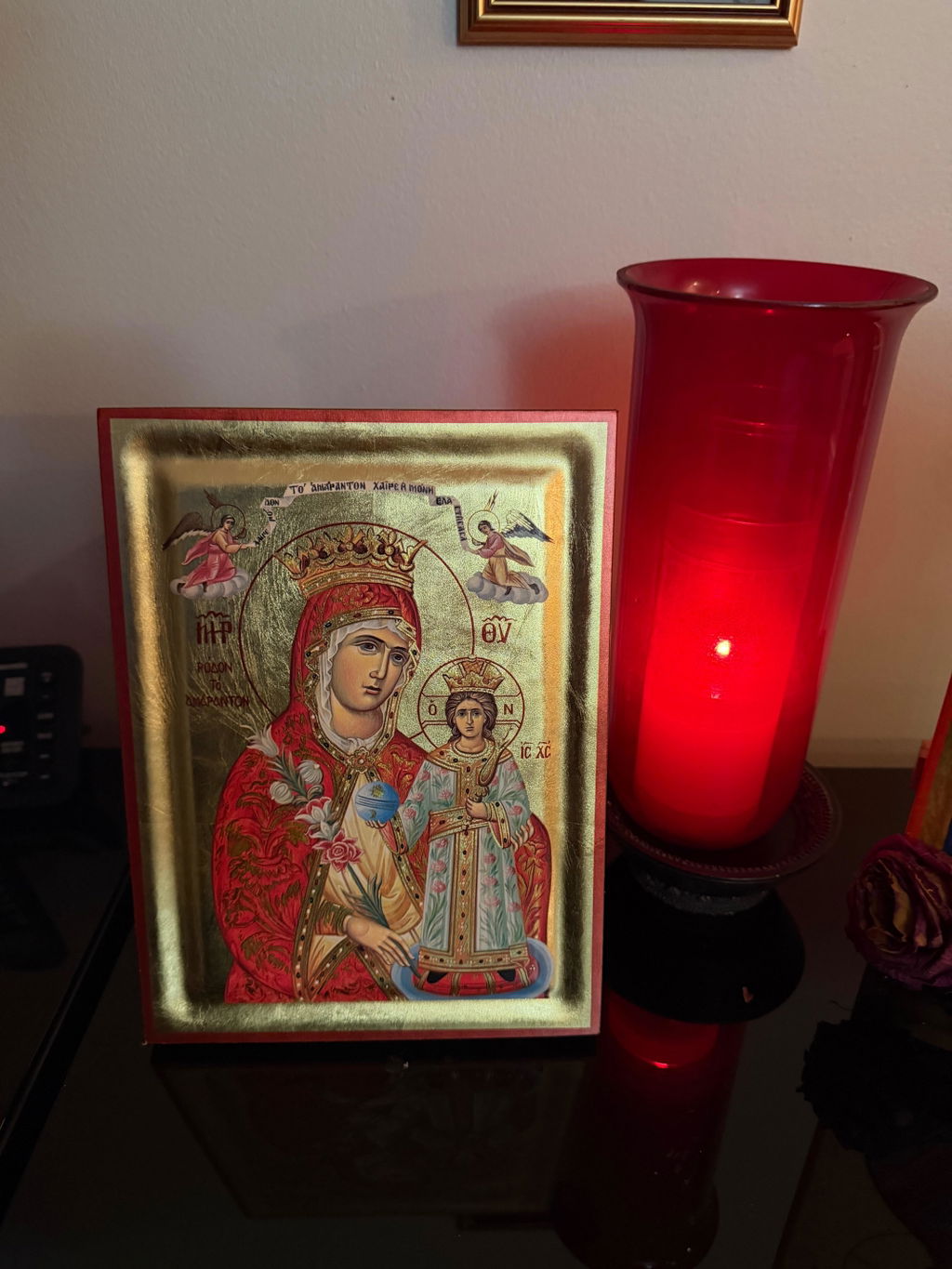
Hodegetria means “She who shows the Way”. Here is the type in an icon from our Exclusive Collection. We cannot say it copies the icon of St. Xenophontos: the small line at its foot names another house of the Holy Mountain.

- ΜΡ ΘΥ · Η ΟΔΗΓΗΤΡΙΑ “Mother of God, the Hodegetria”, written in red beside her halo.
- The pointing hand Her right hand turns towards the Child. She does not point to herself but to her Son, the Way.
- Christ on her left arm He blesses with His right hand and holds a scroll. His halo bears the cross and Ο ΩΝ, “He who is”.
- The red veil A deep red maphorion with gold borders and small gold stars on her brow and shoulder, over a blue cap.
- Two angels Winged angels in the upper corners, each holding an open scroll and marked ΑΓ ΚΥ, “angel of the Lord”.
- Ι.Μ.Ο. ΓΡΗΓΟΡΙΟΥ · ΑΓΙΟΝ ΟΡΟΣ At the foot, in small letters: “Holy Monastery of Osios Grigoriou, Holy Mountain”, a neighbour further down the coast.
When are the feasts of St. Xenophontos Monastery?
St George is honoured on 23 April. At St. Xenophontos the feast begins with an all-night vigil on the eve, followed by the Divine Liturgy.
The coming of the Hodegetria is kept on the first Sunday of October. Vespers are sung on the eve, and bishops and fathers from Vatopedi often join the brotherhood.
Add the feast to your calendar
St. Xenophontos Monastery: a short timeline
- Late 10th century St Xenophon founds a monastery of St George.
- 1544 Antonios paints the frescoes of the old katholikon.
- 1730 By tradition, the Hodegetria icon comes from Vatopedi.
- 1817 Work begins on the new katholikon.
- 1976 Archimandrite Alexios becomes abbot.
The apolytikion of St George
Liberator of captives,
defender of the poor,
physician of the sick,
champion of kings:
trophy-bearer and Great Martyr George,
intercede with Christ our God
that our souls may be saved.
23 April · St George
Tip: print this page and the hymn card prints on its own, clean and simple.
Read the hymn in Greek
Ὡς τῶν αἰχμαλώτων ἐλευθερωτής,
καὶ τῶν πτωχῶν ὑπερασπιστής,
ἀσθενούντων ἰατρός,
βασιλέων ὑπέρμαχος,
Τροπαιοφόρε Μεγαλομάρτυς Γεώργιε,
πρέσβευε Χριστῷ τῷ Θεῷ,
σωθῆναι τὰς ψυχὰς ἡμῶν.
Questions people ask
Who founded St. Xenophontos Monastery?
St Xenophon, a monk of the late 10th century, whose name the monastery still bears. He dedicated it to St George. Today it ranks sixteenth of the twenty ruling monasteries of Mount Athos.
What is the Panagia Hodegetria of Xenophontos?
A wonderworking icon of the Theotokos, usually dated to the 14th century. According to tradition it left Vatopedi in 1730 and was found at St. Xenophontos; after it left Vatopedi again, both monasteries accepted it as her will.
What does Hodegetria mean?
“She who shows the Way”. The Mother of God holds Christ on her arm and points to Him with her right hand, because He is the Way to the Father (John 14:6).
When are the feasts of St. Xenophontos Monastery?
St George, the patron, on 23 April, with an all-night vigil on the eve. The coming of the Hodegetria from Vatopedi on the first Sunday of October.
Can women venerate the Hodegetria of Xenophontos?
Women cannot enter Mount Athos, but the monks have brought the icon to cities in Greece for the faithful to venerate, for example to Chalkida in 2024 and to Marousi, near Athens, in 2025.
Few of us will stand before the pillar of the left choir at St. Xenophontos, yet the Hodegetria still points to her Son wherever she is honoured. Light the lamp before your icons tonight and pray with the monks: “Most Holy Theotokos, save us.”